What you are looking at
The visuals are not improvised
Nothing in that take is being played by hand. Every scene change, every fader
move, every Blitz and Magic toggle is automation drawn into Logic against the track, the same way
you would automate a filter sweep or a reverb send. Filament exposes its parameters to the host,
so the show is written once and performs itself identically every time.
That is what the plugin form is for: a show written once, sitting on the
timeline with the music, moving with the arrangement, and surviving being bounced, recalled and
played back next week.
Live is a different job, and that is what the standalone is for. In a club or a
DJ set there is usually nothing to program against and no session to automate, so Filament takes
the room's audio or a deck output and you drive it by hand, from the phone remote, or let
auto-pilot follow the music on its own. Same engine, same 48 modes either way. What changes is
whether the show is written in advance or played as it happens.
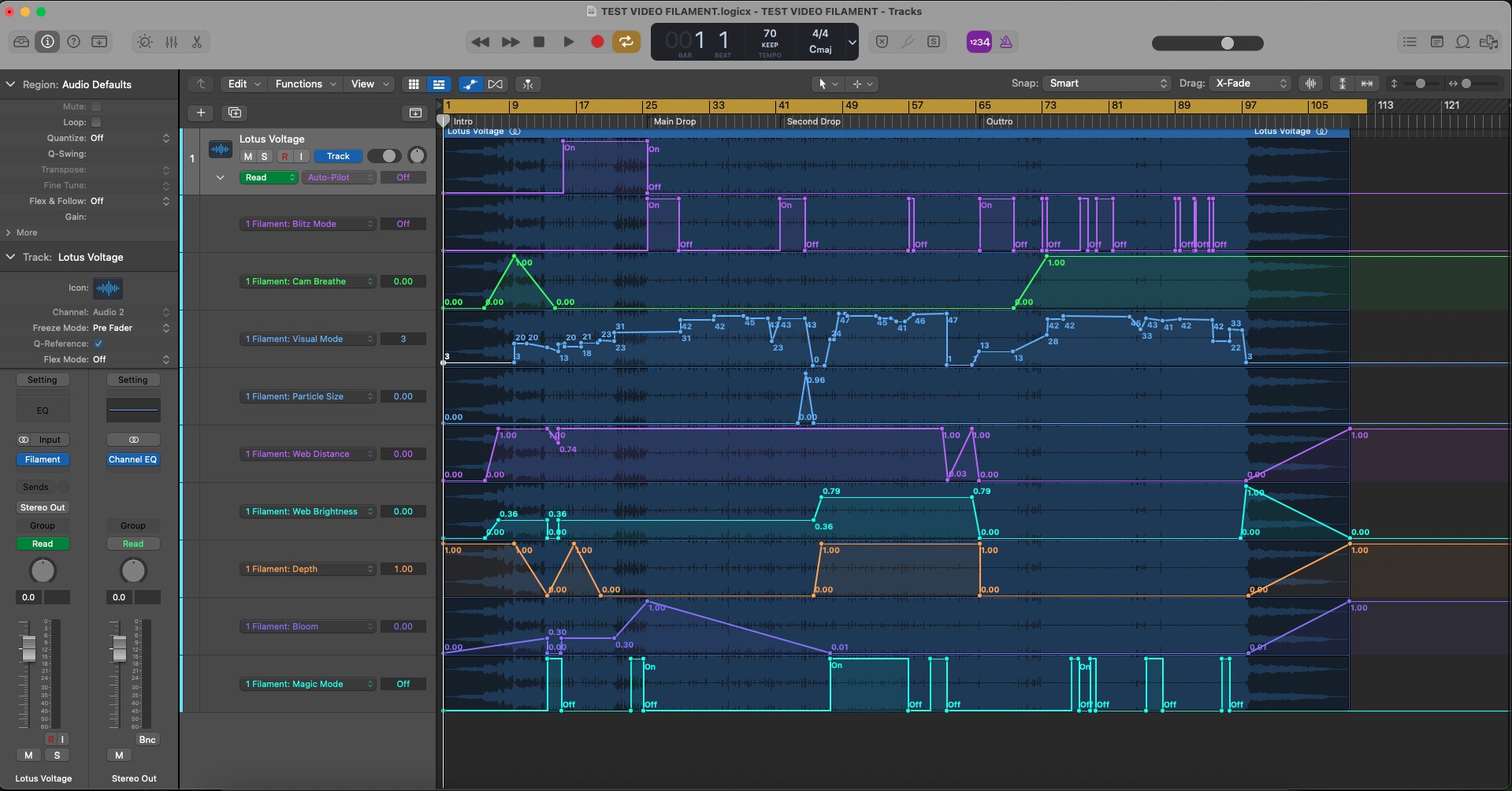
The automation behind the take. Visual Mode steps between scenes across the
arrangement; Blitz and Magic switch on and off at section boundaries; Depth, Bloom, Web and
Breathe are drawn as curves against the waveform.
Why the hardware matters
It runs on the slowest machine we could point it at
This was captured on a 2018 Intel Mac mini using integrated graphics, with
Filament set to Low GPU mode, while Logic Pro was playing the project and a screen recorder was
running at the same time. That is a deliberately unkind test. If it holds up there, it will hold
up on the machine you actually gig with.
The second screen is a real iPad on the same network, connected through the
Remote. It is not a mockup of the interface, it is the interface, mirroring state as the
automation moves it.